
3D Microcoil Fiber Fabrication Technology
Applications: Medical Diagnostics, Microfluidics, Chemical Mixing, Cell Manipulation, etc.
Overview
Conventional microfluidic devices are typically fabricated on flat substrates using lithography—a standard semiconductor manufacturing technique. However, this approach is limited by its inability to create three-dimensional or non-planar channel structures, which restricts the functional complexity of the devices.
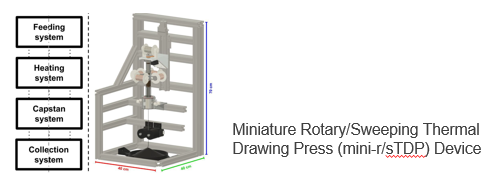
To overcome these limitations, the research team developed a Rotary Thermal Drawing System. This breakthrough equipment enables the production of 3D helical channels and microcoil fibers. Beyond simple fluidics, this technology allows for the integration of electrical components, leading to novel applications such as advanced electrophoresis.
Key features of this technology:
・Flexible design is possible the fiber material (e.g. high‑strength material, elastic materials), diameter size, pitch, shape (liner or spiral), hollow or not, etc.
・Portable size of the equipment Saving space and easy to handle.
Application examples: capillary electrophoresis device (Fig. B) and magnetic stimulation device (Fig. C).
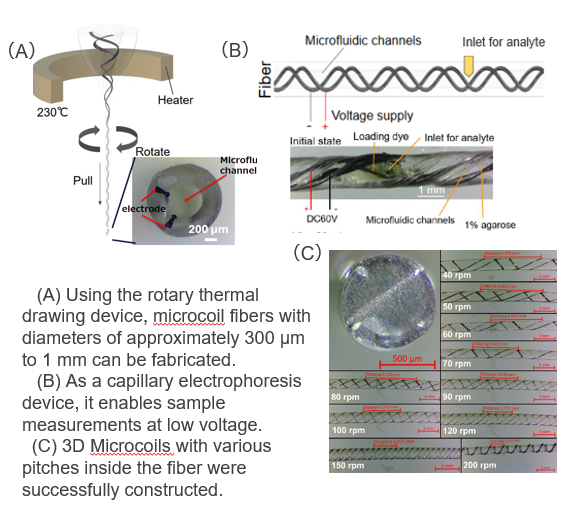
Potential Applications
・Capillary Electrophoresis Devices (Fig. B): For high-precision chemical and biological analysis.
・Magnetic Stimulation Devices: Utilizing the microcoil structure for localized magnetic fields.
・Non-invasive/Non-destructive Testing: Microcoils for high-sensitivity sensors and inspection tools.
・Tailored to your specific needs. Contact us to discuss your potential application.
IP Data
IP No. : JP2024-198881
Inventor : GUO Yuanyuan, LE BOURDONNEC ETIENNE, KARIMATA Sora, KATO Shunsuke
keyword : 3D fiber、microcoil, Capillary Electrophoresis Device, Magnetic Stimulation Device